Selasa, 03 September 2013

Artist - Bernhardt Wall


If you von't, Vy von't you, vot?

3 1/2" x 5 1/2"
circa 1910s
Postcard
by Bernhardt Wall for S Bergman Co
marked: S 68
divided back

Bernhardt Wall (1872 - 1956) earned the nickname, the Postcard King, through the vast amount of design work he did on postcards. His work appears on many different publisher's cards. He is credited as having created over 5000 postcards including many series like the very recognizable Sunbonnet Girls (aka Sunbonnet Sue) and Overalls Boys. These figures wore large white bonnets with red dresses or straw-looking hats with overalls. The hats obscured the faces of these characters. Some of the Ullman cards featuring sunbonnet figures give credit for the illustration to "Uncle Milton", a pen name sometimes used by Wall.  Now whether or not he originated these characters is questionable despite the artist's own claims. Some sources do credit Wall for this, but Bertha L. Corbett who designed the sunbonnet girl for Dutch Cleanser and illustrated a book on sunbonnet babies among other sunbonnet items may more properly deserve credit. None the less, Wall's interpretations remain very popular and there are several groups like a day of the week series and a series of each month of the year (both published by Ullman) to collect. Wall also created characters in wide-brimmed red hats that are similar but whose faces can be seen.


To My Valentine ~ I ain't good looking but, I iss cute, vot?

4" x 2 1/2"
circa 1880s, 1890s
Postcard
by Bernhardt Wall 

for Gibson and Co


As was popular at the time, Wall did many cultural characters like the Dutch themed cards shown here and cards depicting black Americans. His take on African Americans reflects the prejudices common and generally acceptable in the society of his time such as the 1906 series for Ullman titled Cute Coon Series No. 70 and another group also for Ullman titled Little Coon Series No. 59. These were filled with unflattering, stereotypical imagery as one might guess from the chosen titles. Wall was kinder in his depictions of women suffragettes - a topic often derided by some other cartoon card creators. The number of women in the field (well before it was normalized for women to work outside the home, illustration work in books and on cards was often done by women some who became quite famous) ensured that not all treatments of the topic were against votes for women.  He is also well known for his propaganda cards mocking the Germans during WWI. His experiences in Cuba with the military during the Spanish American War probably influenced his desire to participate in WWI in such a way. 

While our interest lies mainly in the valentine cards designed by Wall, his more highly valued work is to be found in the etchings he created, especially those he created to go along with his work as a historian. It is thought that his postcards earned the money to enable Wall to do his preferred work as a lithographic artist which was not as lucrative at the time. According to a story in the July 15th, 1916 edition of Bruno's Weekly, Wall was fond of traveling in his car with plates at the ready to etch things as they struck his fancy. He preferred this to asking people to sit in a studio for him. It is claimed he did such an etching of Mark Twain as Twain spoke at a branch of New York City's YMCA.

As well as his work published by a variety of companies, Wall published quite a bit of his own work too. Many of his books and other items such as bookplates were created by the artist himself. These items tend to be rather difficult to come by as quantities were more limited than his postcard designs. Other difficult to find items include water colors, such as his 1898 paintings of scenes of Cuba found in the collection of the Natural History Museum of Los Angeles County.

Political figures were also a favorite subject appearing in etchings and as subjects for both postcards and books. He did a series of 'Following' books: Following General Sam Houston 1793-1863 (1935), Following Andrew Jackson (1937), etc. Of special interest among his publications is the series of miniatures from 1948, The Etcht Miniature Magazine. Each volume in the 12-month series was limited to 60 copies with text and illustrations all etched and printed in colored inks.

Wall died on February 9, 1956 in California, which had been his home since the death of his first wife. He was by that time considered a respected historian of the American West. His books, which he printed and bound himself, are to be found in the collections of several well-regarded universities as well as those of many prominent collectors. 


 ************************************************************** 

Companies Wall is known to have worked for:

  • Barton and Spooner
  • Bergman
  • Gibson Art Co
  • Illustrated Postal Card Co
  • International Art Co
  • J. I. Austen
  • Ullman Mfg Co
  • Valentine and Sons

Sources: 

  • Bruno's Weekly, July 15, 1916
  • The Bookseller, Newsdealer and Stationer, Vol 43, July 15, 1915, p 98
  • Antique Trader Black American Price Guide by Kyle Husfloen

Senin, 02 September 2013


Valentine is pleased to present
Paintings and Sculptures
by  
Charlotte Becket 
and
 Emmy Mikelson


Opening 
Friday September 13 from 6-9
with drawings by Robert Egert.


This exhibit will run through Sunday October 6.
The gallery hours are Friday - Sunday from 1-6 and by appointment.
Valentine is located at 464 Seneca Ave Ridgewood NY
The L line at the DeKalb station
or the M Line at the Seneca station

Senin, 12 Agustus 2013

Maker - Doubl-Glo


This Valentine's an old antique, For each year-r on this day Aye sent it out wi' this request: RETURN WITHOUT DELAY! but-Yir-r so sweet, 'tis yir-rs T'keep wi' ever-ry wor-r-d upon it! 'Cause all aye want is You, Dear-r -- wi' a small DEPOSIT on it!

4 3/4" x 5 3/4"  (5 3/4" x 9 1/2" opened)
circa 1940s,  1950s
 French Fold
 made in USA
 by Doubl-Glo
 marked: T-765


My Sweet Valentine Do I love YOU? ~ You can bet your BOOTS I do!

3 1/2" x 4 1/4" (4 1/4" x 6 3/8" opened)
circa 1930s, 1940s
assymetrical french fold
by Doubl-Glo
features a white cat


Doubl-Glo is a trademark used by the Paper Novelty Company of Stamford, Connecticut. The company started out making a folded paper Christmas bell, but in 1932 began making their most famous product - their tinsel in the familiar package with Santa on it.


To My Valentine  Blowing bubbles would be more fun ~ If I found you inside of one
5 1/2" x 4" (5 1/2" x 8" opened)
1940s, 1950s
French Fold
by Doubl-Glo
made in USA
marked: 700


It is not clear when they began making greeting cards. Their focus was much more on Christmas items than on valentines. 

To My Valentine Hung out my Shingle, As you can see, Tho' I'm not a Dentist Nor M.D. ~ I'll treat YOU as my clientele And practice LOVE for quite a spell Practice with You will be perfect.

3 7/8" x 4 3/4" (4 3/4" x 7 1/2 opened)
circa 1940s, 1950s
Modified French Fold
made in USA
by Doubl-Glo
marked: P 8700-4


**********************************************************

Sources:

The Daily Messenger, June 7th, 1967, Canandaigua, NY, p18 

Sabtu, 10 Agustus 2013

Maker - Pleasant Thoughts


A Valentine for Someone I haven't Forgotten ~ A Valentine with hearts and flowers To wish you only happy hours...A Valentine to tell you, too, That someone thinks a lot of you.

9 1/2" x 7 1/2" (9 1/2" x 22 3/4" flat)
circa 1950s
Standing Fold-Out
by Pleasant Thoughts
marked: Made in USA over an FH
100VP13

with pink paper puff hearts

Pleasant Thoughts was founded sometime in the 1950s by Kenneth Walker in Waukegan, Ill. The company was very successful and sold to Gibson in 1962. Gibson kept the name up as a line and last renewed the trademark on the name on August 8th, 2002. 

After the sale of Pleasant Thoughts, Walker went on to found another very successful company,  Advantage Rent-A-Car.


*************************************************

 Sources:

Obituary for Kenneth Walker, January 18th, 2005, Auto Rental News


Selasa, 06 Agustus 2013

Art Deco (Page 2)


My Valentine Here goes another postage stamp To your same old address I always was a wasteful scamp (I waste my love, I guess).

5 1/2" x 4 1/2"
circa 1920s, 1930s 
Flat
 no publisher's marks

To You, on St. Valentine's - I suppose it wouldn't do If I should say to you 'I love you' But I'll greet you anyway For I see no harm, do you If I change the wording to, 'I like you' On St Valentine's Day?

4 1/2" x 2 1/2"
circa 1920s, 1930s
Flat
 marked: 1015 V


To My Valentine with Love.

2 7/8" x 3 5/8"
circa 1920s, 1930s
Stand-Up
marked: made in USA


A Valentine Message to my Sweetheart. I love you heaps and heaps and heaps, I'm going to love you, too, - for keeps; I want you near me all life through ~ With all my heart and soul ~ ~ I do!

5 3/8" x 4 3/8"
circa 1920s, 1930s
Flat
with coordinating envelope

I extend to you a hearty Invitation to my party; 'Twill be a love feast for us three ~ For you, For cupid and for me.

3 1/2" x 5 3/4"
6 3/4" x 5 3/4" (opened)
made in the USA
circa 1930s


Flowers, like in the bouquet above, were often drawn in swirled circles. Also widely seen was gold detailing, and figures, often very thin, with curling hair and billowing skirts. 

Don't Turn me Down my Valentine.

3 3/4" x 3 1/4"
circa 1920s, 1930s
Flat

A Valentine To Mama, Because ~ She's still my best Girl.

3 1/2" x 4 1/2" (3 1/2" x 9" opened)
circa 1920s, 1930s
Single Fold


Valentine greetings ~ This is the happy day of hearts So with my greetings true, I send a wish straight from my heart For happiness to you.

2 1/2" x 4 3/8" (4 3/8 x 6 3/4" opened)
circa 1920s, 1930s 
 Tri-Fold

♥♥♥♥♥♥♥♥♥♥♥♥♥♥♥♥♥♥♥♥♥♥♥♥♥♥♥♥♥♥♥♥♥♥♥♥♥♥♥♥♥♥♥♥♥
More Art Deco Cards:


♥♥♥♥♥♥♥♥♥♥♥♥♥♥♥♥
Click here to browse Art Deco cards for sale in our store.

Senin, 05 Agustus 2013

Maker - Hallmark, Hall Brothers


Valentine Greetings to You ~ You're sure as nice can be, And mighty nice to know, And you're Somebody's Valentine! This little birdie told me so!

4" x 5 3/4" (5 3/4" x 7 7/8 opened)
dated 1940
Flat
Made in USA
by Hallmark
Hall Brothers Inc

Hallmark officially began as an endeavor by Joyce Clyde Hall in 1910 upon his arrival in Kansas City, Missouri. The company's roots lie, however, in Norfolk, Nebraska. It was there that Joyce's brothers, Rollie and William, purchased the Norfolk Post Card Company, a bookstore, in 1891. By 1894, they had moved into the wholesaling of postcards.

When Joyce arrived in Kansas City he came with a box full of postcards and his own plan to delve into the wholesaling of those cards. Was it a fit of sibling rivalry that sent Joyce almost 300 miles away to form his own start-up in competition with his brothers? Or maybe Joyce saw great possible benefit in the move to Missouri where his brothers did not? Whatever the motivations, the move and resulting new business proved to be a tremendous success that the brothers would all come to share in and contribute to. 


For a SWEET LITTLE NIECE on Valentine's Day.

6 1/4" x 7 5/8"
circa 1950s 
Flat with Easel Stand
 by Hallmark
marked: 25v 629-1
 with bow detail

From a room at the YMCA, Joyce mailed out batches of 100 cards to various stationers and booksellers. For his efforts, some kept the cards, making no payment; others mailed them back with strongly worded missives. Just enough, however, opted to keep the cards and mail a check. From there, Joyce built up sales until the volume of mail to that YMCA room prompted him to rent out office space. The company was up and running strong very quickly.

After his brother Rollie joined him in Kansas City in 1911, they began operating as Hall Brothers. William would join Joyce and Rollie in the 1920s. Initially, they sold items printed by other printers. After losing their entire inventory in a January 1915 fire, they decided to start anew, but this time printing their own cards. By Christmas they were up and going again. These new cards would now all be marked on the back with the Hall Brothers' name. This was a time when postcards were beginning to decline in popularity and the Hall brothers thought they would find a market for cards that were mailed in an envelope - offering a bit more privacy than a postcard. This proved to be very true and quite a success for the brothers who were now printing and selling cards for Valentine's Day and Christmas. Another of their innovations was commercially made gift wrap debuting in 1917. Like Gibson, the Hall Brothers also excelled at sales innovations and merchandising.


A Valentine for You Here's a little Valentine That I just went an' got -- Specially on accounts 'cause ~ I like you such a lot!

4 1/8" x 5 3/8" (5 3/8" x 8 3/8" opened)
dated 1946
French Fold
made by Hall Bros
marked: Hallmark Rufftex
15 V106-6


By 1922 the company had grown to more than 100 people and they were producing cards for a dizzying array of holidays, events, and occasions. In 1928 they began using Hallmark in addition to the company name, Hall Brothers. Joyce (known as J.C.) was said to have liked its reference to the guarantee of quality it indicates on precious metals.

Stop! And be my Valentine!

2 1/4" x 3 1/4"
circa 1960s
Flat
by Hallmark
made in USA

1932 brought a deal with Walt Disney that continues today. While I have seen several Disney licensed cards from the 1930s, I have not seen any from that time that also include a Hall Brothers or Hallmark logo. If anyone, dear readers, has any such cards we'd be very curious to see scans of them (please leave a comment if you are so lucky and willing to share). 

Similar deals with other artists were made. Norman Rockwell and Grandma Moses are among those whose work adorns Hallmark greeting cards. 

In 1939, Hallmark created what would come to be one of the all-time most popular greeting cards - their 'pansy' Mother's Day card. The front reads: To let you know I'm thinking of you. The message that follows inside: Pansies always stand for thoughts - at least that's what folks say. So this just comes to show my thoughts are there with you today. The front of the card features an image by Dorothy Maienschein which was also used in a 'love' stamp issued by the USPS in 2010. The card is die-cut and features purple pansies in a wheelbarrow-shaped planter. Hallmark quickly recognized its potential and reissued the card as a 'friendship' card in 1941. The card remains available today and has sold 30 million copies.

Andrew Szoeke designed the now familiar Hallmark 'crown' logo (featuring a crown above the Hallmark name) in 1949. Still, the official change in name from Hall Brothers to Hallmark was not until 1954. This means there are many cards marked with both names and some from that narrow 5-year window with both Hall Brothers and the 'crown' logo version of Hallmark

Like the crown logo, Hallmark's tag line - when you care to send the very best -  has a long history with the company. It first appeared in 1944, written by Ed Goodman, and endures to this day. It is a clever line in its simplicity, that keeps it from sounding outdated despite its advanced age.

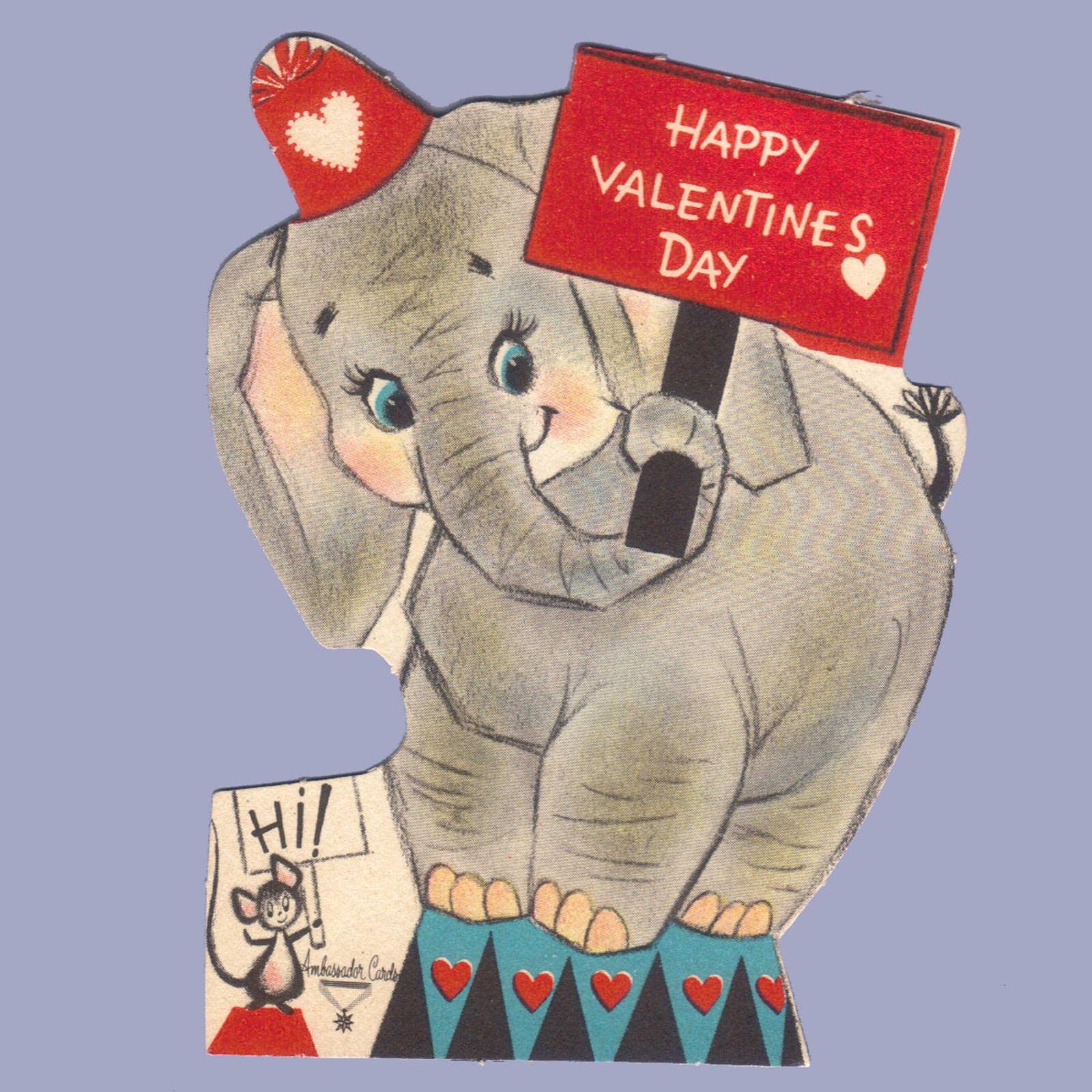
Hi! Happy Valentine's Day.

2 3/4" x 3 3/4"
circa 1960s
Flat
Ambassador Cards
by Hallmark

Ambassador Cards was launched by Hallmark in 1959. It was a widely advertised line with great volumes of each item produced. The Shoebox line and its popular character Maxine were added in 1986. Hallmark continues on today, having branched out well beyond their initial Kansas City greeting card business to have interests in many areas. They employ thousands of people with about 4,500 of those still located in Kansas City, Mo.

************************************************************************

Sources: 

The Romance of Greeting Cards, Ernest Dudley Chase (revised edition of 1956)  
Valentine Treasury - A Century of Valentine Cards, by Robert Brenner
The Encyclopedia of Greeting Card Tools and Techniques, Susan Pickering Rothamel

Butterflies


Best Valentine Wishes ~ Can't I coax you to be mine Little lady valentine? Poppies are red, violets are blue, And I'd be true as long as you.

2 5/8" x 3 3/4" (3 3/4" x 5 1/4")
circa 1920s
Single Fold
by Whitney Made


 Just a BUTTERFLY? Fly my way, Valentine!

4 1/2" x 2"
circa 1950s, 1960s
Flat
made in USA